
The Constitution of India is the supreme law of the country and forms the foundation of Indian democracy. It defines the structure, powers, functions, and responsibilities of the government and guarantees the rights and duties of citizens. The Constitution provides a framework for governance and ensures justice, equality, liberty, and democracy in the nation.
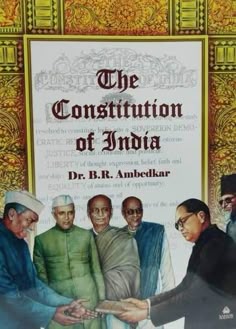
The Constitution of India was adopted by the Constituent Assembly on 26 November 1949 and came into effect on 26 January 1950, celebrated every year as Republic Day. Dr. B. R. Ambedkar is known as the chief architect of the Indian Constitution because of his significant contribution in drafting it.
Meaning of the Constitution of India
The Constitution of India is a written document that contains laws, principles, and rules according to which the country is governed. It explains the relationship between citizens and the government and distributes powers among different organs of the state.
It ensures that the government functions within constitutional limits and protects the democratic rights of citizens.
Historical Background
Before independence, India was governed under British laws such as the Government of India Acts. After independence in 1947, the need for an independent constitution was felt to establish democratic governance.
The Constituent Assembly was formed to draft the Constitution. The drafting committee was chaired by Dr. B. R. Ambedkar. After extensive discussions and debates, the Constitution was finally adopted in 1949.

Features of the Constitution of India
The Constitution of India has several unique features that make it one of the most detailed constitutions in the world.
1. Longest Written Constitution
The Indian Constitution is the longest written constitution in the world. It contains detailed provisions related to administration, rights, governance, elections, judiciary, and emergency powers.
2. Parliamentary System of Government
India follows the parliamentary system where the Prime Minister is the real executive head and the President is the constitutional head.
3. Federal System with Unitary Features
The Constitution divides powers between the central government and state governments. However, during emergencies, the central government becomes more powerful.
4. Fundamental Rights
The Constitution guarantees Fundamental Rights to citizens to ensure freedom, equality, and justice.
5. Directive Principles of State Policy
These principles guide the government in making laws and policies for social and economic welfare.
6. Independent Judiciary
The judiciary works independently to protect the Constitution and rights of citizens.
7. Secular State
India respects all religions equally and has no official religion.
8. Single Citizenship
Unlike some countries, India provides single citizenship to all citizens.
Preamble of the Constitution of India
The Preamble is the introduction to the Constitution and reflects its philosophy and objectives. It declares India as a:
- Sovereign
- Socialist
- Secular
- Democratic
- Republic
The Preamble also ensures:
- Justice
- Liberty
- Equality
- Fraternity
It represents the ideals and aspirations of the people of India.

Fundamental Rights
Fundamental Rights are essential rights guaranteed by the Constitution to every citizen. These rights protect individuals from discrimination and misuse of power.
Types of Fundamental Rights
- Right to Equality
- Right to Freedom
- Right against Exploitation
- Right to Freedom of Religion
- Cultural and Educational Rights
- Right to Constitutional Remedies
These rights are enforceable by courts.
Fundamental Duties
Fundamental Duties were added by the 42nd Constitutional Amendment Act in 1976. These duties encourage citizens to respect the Constitution, national symbols, and maintain harmony and unity.
Directive Principles of State Policy
Directive Principles are guidelines for the government to establish social and economic democracy. Although they are not enforceable in courts, they are important for policy-making.
Examples include:
- Equal pay for equal work
- Promotion of education
- Protection of environment
- Welfare of weaker sections
Structure of Government
The Constitution of India establishes three organs of government:
Legislature
Makes laws for the country. Parliament is the legislative body at the central level.
Executive
Implements laws and manages administration. The President, Prime Minister, and Council of Ministers form the executive.
Judiciary
Interprets laws and protects constitutional values. The Supreme Court is the highest court in India.
Importance of the Constitution of India
The Constitution of India plays a vital role in maintaining democracy and stability in the country.
Protects Democracy
It ensures that the government is elected by the people and functions democratically.
Safeguards Rights
It protects the rights and freedoms of citizens.
Maintains Balance of Power
The Constitution distributes powers among different organs and levels of government.
Promotes Equality
It guarantees equality before law and prohibits discrimination.
Ensures Justice
The Constitution promotes social, economic, and political justice.
Parts of the Constitution of India
The Constitution of India is divided into different Parts to organize laws, rights, duties, and government functions systematically. Originally, the Constitution had 22 Parts, but after various amendments, it now contains 25 Parts, more than 450 Articles, and 12 Schedules.
Below are the important Parts of the Constitution of India:
| Part | Articles | Subject |
|---|---|---|
| Part I | Article 1-4 | The Union and its Territory |
| Part II | Article 5-11 | Citizenship |
| Part III | Article 12-35 | Fundamental Rights |
| Part IV | Article 36-51 | Directive Principles of State Policy |
| Part IVA | Article 51A | Fundamental Duties |
| Part V | Article 52-151 | The Union Government |
| Part VI | Article 152-237 | State Governments |
| Part VII | Repealed | Earlier related to Part B States |
| Part VIII | Article 239-242 | Union Territories |
| Part IX | Article 243-243O | Panchayats |
| Part IXA | Article 243P-243ZG | Municipalities |
| Part IXB | Article 243ZH-243ZT | Cooperative Societies |
| Part X | Article 244-244A | Scheduled and Tribal Areas |
| Part XI | Article 245-263 | Relations between Union and States |
| Part XII | Article 264-300A | Finance, Property, Contracts and Suits |
| Part XIII | Article 301-307 | Trade and Commerce |
| Part XIV | Article 308-323 | Services under Union and States |
| Part XIVA | Article 323A-323B | Tribunals |
| Part XV | Article 324-329A | Elections |
| Part XVI | Article 330-342 | Special Provisions for Certain Classes |
| Part XVII | Article 343-351 | Official Language |
| Part XVIII | Article 352-360 | Emergency Provisions |
| Part XIX | Article 361-367 | Miscellaneous |
| Part XX | Article 368 | Amendment of the Constitution |
| Part XXI | Article 369-392 | Temporary, Transitional and Special Provisions |
| Part XXII | Article 393-395 | Short Title, Commencement and Repeals |
Important Parts for Competitive Exams
Part III – Fundamental Rights
Contains rights like equality, freedom, and constitutional remedies.
Part IV – Directive Principles
Guidelines for the government to establish social and economic justice.
Part IVA – Fundamental Duties
Lists duties of citizens toward the nation.
Part XVIII – Emergency Provisions
Explains National, State, and Financial Emergencies.
Part XX – Amendment of Constitution
Describes the process of constitutional amendments.
Importance of Parts of Constitution
- Helps in systematic understanding of the Constitution
- Important for UPSC, SSC, Banking, Railway, and State PCS exams
- Useful in understanding governance and legal structure
- Frequently asked in competitive examinations
Conclusion
The Constitution of India is the backbone of Indian democracy and governance. It protects the rights of citizens, defines the structure of government, and ensures justice, liberty, equality, and fraternity. Understanding the Constitution is essential for every citizen and extremely important for competitive exam preparation. With proper study and regular revision, students can master this topic and achieve success in government exams.
Why Study the Constitution of India with Dishafy?
Dishafy provides easy-to-understand notes, quizzes, mock tests, and exam-oriented study material for competitive exam aspirants. Our content helps students build strong conceptual understanding and improve their scores.