
Salient Features of The Indian Constitution
Introduction
The Constitution of India is the supreme law of the land and forms the foundation of the country’s political, legal, and administrative system. It defines the powers and responsibilities of the Union and State governments, guarantees the rights of citizens, and establishes the framework for governance. The Constitution reflects the aspirations of the Indian people for justice, liberty, equality, and fraternity.
The Constitution was adopted on 26 November 1949 by the Constituent Assembly and came into force on 26 January 1950, a day celebrated annually as Republic Day. Drafted under the chairmanship of Dr. B. R. Ambedkar, it is regarded as one of the most comprehensive and progressive constitutions in the world.
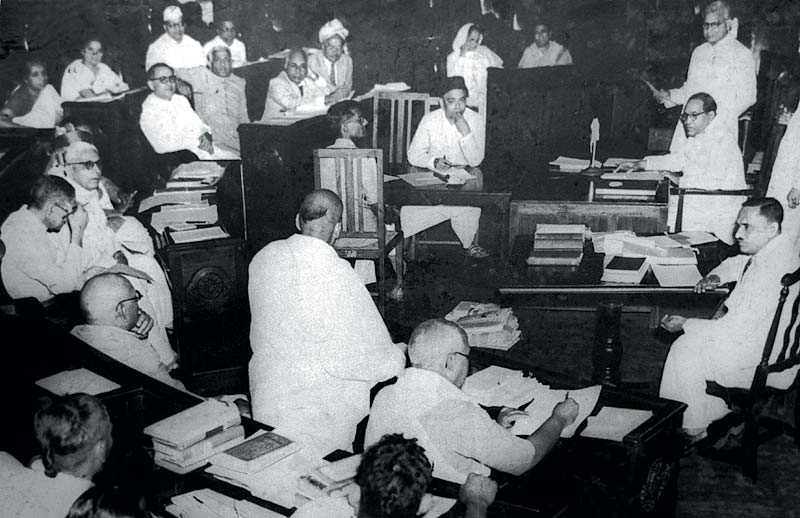
A Constituent Assembly of India meeting in 1950
Historical Background
The demand for a written Constitution gained momentum during India’s struggle for independence. The Constituent Assembly was formed in 1946 to draft a constitution suitable for an independent democratic nation.
Important Facts
- Constituent Assembly formed: December 1946
- Chairman of Drafting Committee: Dr. B. R. Ambedkar
- Constitution adopted: 26 November 1949
- Constitution came into force: 26 January 1950
- Time taken to draft: 2 years, 11 months, and 18 days
- Total sittings of Constituent Assembly: 11 sessions over 165 days
Salient Features of the Indian Constitution
Lengthiest Written Constitution in the World
The Indian Constitution is the longest written Constitution among sovereign nations. Unlike countries with unwritten constitutions, India has a single, detailed document covering almost every aspect of governance.
Why is it so lengthy?
Several factors contributed to its extensive nature:
- Vast geographical and cultural diversity
- Detailed provisions for Union and State governments
- Inclusion of Fundamental Rights and Directive Principles
- Special provisions for Scheduled Areas and Tribal Areas
- Administrative details
- Emergency provisions
- Election procedures
- Local self-government
- Constitutional bodies
Present Structure (2026)
- 470 Articles
- 25 Parts
- 12 Schedules
The Constitution has evolved through numerous amendments while retaining its core democratic values.
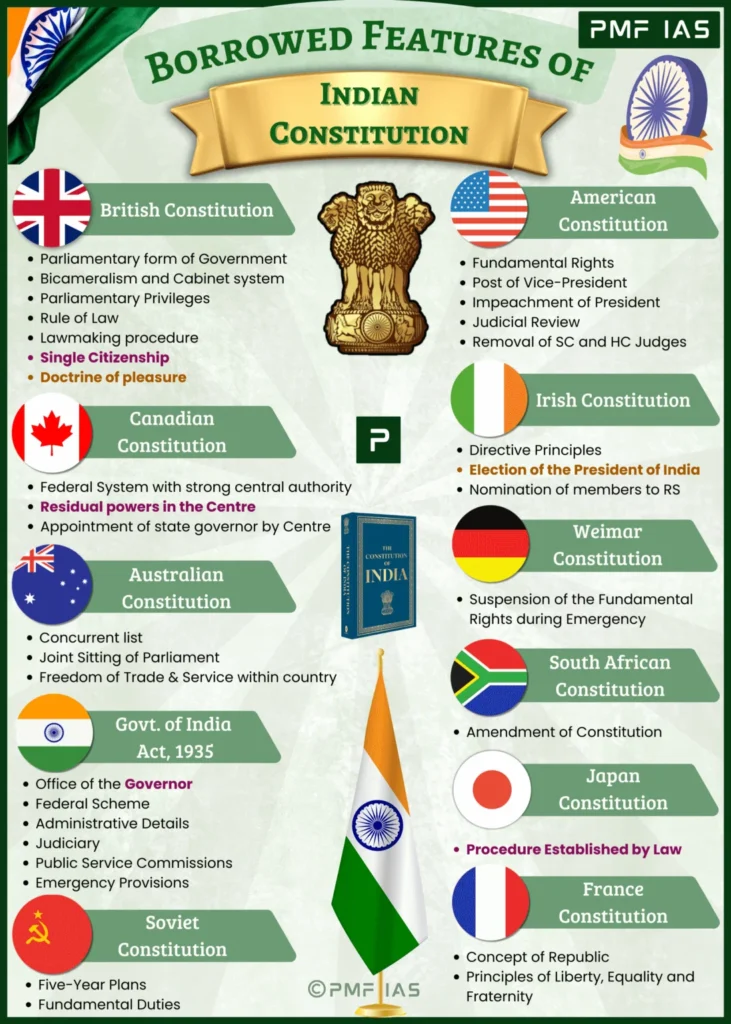
Constitution Drawn from Various Sources
The Indian Constitution is often described as a “Bag of Borrowings.” The framers carefully studied constitutions from different countries and adopted features best suited to Indian conditions.
| Country | Features Borrowed |
|---|---|
| United Kingdom | Parliamentary Government, Rule of Law, Single Citizenship, Cabinet System |
| United States | Fundamental Rights, Judicial Review, Independent Judiciary, Impeachment |
| Ireland | Directive Principles of State Policy |
| Canada | Federal System with Strong Centre |
| Australia | Concurrent List, Freedom of Trade |
| Germany | Emergency Provisions |
| Soviet Union | Fundamental Duties |
| South Africa | Amendment Procedure |
| Japan | Procedure Established by Law |
The borrowed features were adapted to India’s unique social, cultural, and political environment.
Sovereign, Socialist, Secular, Democratic Republic
The Preamble describes India as a Sovereign Socialist Secular Democratic Republic.
Sovereign
India is completely independent in internal and external affairs. It is free to make laws and policies without interference from any external authority.
Socialist
The Constitution aims to reduce inequalities by promoting social and economic justice. It supports welfare measures such as education, healthcare, employment opportunities, and poverty alleviation.
Secular
India has no official religion. Every citizen enjoys the freedom to profess, practice, and propagate any religion while the State treats all religions equally.
Democratic
The government is elected by the people through universal adult suffrage. Citizens actively participate in governance through free and fair elections.
Republic
The Head of the State (President) is elected rather than inheriting the office through monarchy.

The Preamble to the Indian Constitution of India is a brief introductory statement that reflects the hopes and aspirations of the people. The preamble can be referred to as the preface which highlights the entire Constitution. It embodies the basic philosophy and the fundamental values on which our constitution is based.
Parliamentary Form of Government
India follows the British model of parliamentary democracy.
Features
- President acts as the constitutional head.
- Prime Minister is the real executive authority.
- Council of Ministers assists and advises the President.
- Ministers are collectively responsible to the Lok Sabha.
- Executive remains accountable to Parliament.
Advantages
- Ensures accountability.
- Encourages cooperation between executive and legislature.
- Allows quick removal of inefficient governments through votes of no confidence.
Federal System with Unitary Bias
India has a federal structure with a strong central government.
Federal Features
- Written Constitution
- Division of powers
- Independent Judiciary
- Bicameral Legislature
- Constitutional supremacy
Unitary Features
- Single Constitution
- Single Citizenship
- Strong Centre
- Emergency provisions
- Appointment of Governors by the Centre
- Parliament’s power to legislate on State subjects during emergencies
This unique arrangement helps maintain national unity while accommodating regional diversity.
Blend of Rigidity and Flexibility
The Constitution can be amended to meet changing social, political, and economic needs.
Types of Amendments
Simple Majority
Used for ordinary matters like changing state boundaries.
Special Majority
Requires approval by two-thirds of members present and voting, along with a majority of the total membership.
Special Majority with State Ratification
Required for amendments affecting the federal structure.
This balanced amendment process ensures stability while allowing necessary reforms.
Fundamental Rights
Fundamental Rights are guaranteed under Part III (Articles 12–35). These rights protect individual liberty and limit arbitrary state action.
Right to Equality (Articles 14–18)
Ensures equality before law, prohibits discrimination, abolishes untouchability, and abolishes titles (except military and academic distinctions).
Right to Freedom (Articles 19–22)
Includes:
- Freedom of speech and expression
- Freedom of assembly
- Freedom of association
- Freedom of movement
- Freedom of residence
- Freedom to practice any profession
It also provides safeguards against arbitrary arrest and detention.
Right Against Exploitation (Articles 23–24)
- Prohibits human trafficking
- Prohibits forced labour
- Prohibits child labour in hazardous industries
Right to Freedom of Religion (Articles 25–28)
Guarantees freedom of conscience and religion.
Cultural and Educational Rights (Articles 29–30)
Protects linguistic and religious minorities.
Right to Constitutional Remedies (Article 32)
Citizens may directly approach the Supreme Court for enforcement of Fundamental Rights. Dr. B. R. Ambedkar described Article 32 as the “Heart and Soul of the Constitution.”
Directive Principles of State Policy
Contained in Part IV (Articles 36–51).
These principles guide governments in making laws and policies aimed at establishing social and economic democracy.
Objectives
- Reduce poverty
- Promote equal justice
- Improve public health
- Ensure free legal aid
- Protect the environment
- Organize village panchayats
- Promote international peace
Though not enforceable by courts, they are fundamental to governance.
Fundamental Duties
Fundamental Duties were introduced through the 42nd Constitutional Amendment (1976) and expanded by the 86th Amendment (2002).
There are 11 Fundamental Duties, including:
- Respect the Constitution and National Flag
- Protect public property
- Promote harmony
- Preserve India’s heritage
- Protect the environment
- Develop scientific temper
- Safeguard national unity
- Provide educational opportunities to children (for parents/guardians)
These duties encourage responsible citizenship.
Independent Judiciary
India has an independent judicial system that acts as the guardian of the Constitution.
Functions
- Interpretation of the Constitution
- Protection of Fundamental Rights
- Judicial Review
- Settlement of disputes between Centre and States
- Ensuring constitutional supremacy
The judiciary’s independence strengthens the rule of law and protects democracy.
Single Citizenship
Unlike some federal countries such as the United States, India provides only one citizenship.
Benefits
- Promotes national integration
- Ensures equal rights across the country
- Facilitates free movement and employment
Universal Adult Franchise
Every Indian citizen aged 18 years or above has the right to vote regardless of religion, caste, gender, education, or wealth.
This principle ensures equal political participation and strengthens democracy.
Rule of Law
The Constitution guarantees that:
- Everyone is equal before the law.
- Government actions must follow legal procedures.
- No person, including government officials, is above the law.
This principle protects citizens from arbitrary governance.
Independent Constitutional Bodies
The Constitution establishes several independent institutions to ensure transparency and accountability.
These include:
- Election Commission of India
- Comptroller and Auditor General (CAG)
- Union Public Service Commission (UPSC)
- Finance Commission
- National Commissions for Scheduled Castes, Scheduled Tribes, and other constitutional bodies
These institutions function independently of political influence.
Emergency Provisions
The Constitution empowers the President to proclaim emergencies under specific circumstances.
National Emergency (Article 352)
Declared during war, external aggression, or armed rebellion.
President’s Rule (Article 356)
Imposed when a State government cannot function according to constitutional provisions.
Financial Emergency (Article 360)
Declared when India’s financial stability is threatened.
Emergency provisions enable the Union government to take extraordinary measures while safeguarding national interests.
Integrated Judicial System
India has a unified judicial system consisting of:
- Supreme Court
- High Courts
- District Courts
- Subordinate Courts
This integrated structure ensures uniform application of laws across the country.
Local Self-Government
The 73rd and 74th Constitutional Amendments granted constitutional status to Panchayats and Municipalities.
Objectives
- Decentralization of power
- Greater public participation
- Grassroots democracy
- Local development
This system empowers local communities to participate in governance.
Welfare State
The Constitution seeks to establish a welfare state by promoting:
- Social justice
- Economic development
- Public education
- Healthcare
- Employment
- Social security
- Equal opportunities
Government policies are expected to improve citizens’ quality of life.
Judicial Review
Judicial Review empowers the Supreme Court and High Courts to examine whether laws or executive actions conform to the Constitution.
If any law violates constitutional provisions, the courts can declare it unconstitutional.
This mechanism safeguards constitutional supremacy and protects citizens’ rights.
Balance Between Rights and Duties
The Constitution strikes a balance between individual freedoms and social responsibilities. While citizens enjoy Fundamental Rights, they are also expected to fulfill Fundamental Duties and respect the rights of others. This balance is essential for maintaining democratic order and national unity.
Conclusion
The salient features of the Indian Constitution reflect the vision of its framers to create a democratic, inclusive, and progressive nation. By combining the best constitutional practices from around the world with India’s unique needs, the Constitution has provided a stable framework for governance for more than seven decades. Its emphasis on justice, liberty, equality, fraternity, federalism, secularism, judicial independence, and the protection of citizens’ rights continues to guide the world’s largest democracy. As a living document, it evolves through amendments and judicial interpretation while preserving its Basic Structure, ensuring that the core values of the Constitution remain intact for future generations.