
The Mughal Empire was one of the most powerful and influential empires in Indian history. It ruled large parts of the Indian subcontinent from 1526 to 1857 and played a major role in shaping India’s political, cultural, and architectural landscape. The Mughal Empire is known for its strong administration, rich culture, and magnificent monuments.
📜 The Origin
The Mughal Empire was founded by Babur in 1526 after he defeated Ibrahim Lodi in the First Battle of Panipat. Babur was a descendant of Timur and Genghis Khan, which gave him strong military and leadership skills.
The establishment of the Mughal Empire marked the beginning of a new era in Indian history, bringing Central Asian influences into the region.
👑 Important Rulers
1. Babur (1526–1530)
Babur laid the foundation of the Mughal Empire. He introduced new military techniques like gunpowder and field artillery, which helped him win battles.
2. Humayun (1530–1540, 1555–1556)
Humayun faced challenges from Afghan rulers and lost his empire for a period but later regained it with Persian support.
3. Akbar (1556–1605)
Akbar is considered the greatest ruler of the Mughal Empire. His achievements include:
- Religious tolerance (Din-i-Ilahi)
- Efficient administration (Mansabdari system)
- Expansion of the empire across North India
Akbar strengthened the Mughal Empire politically and culturally.
4. Jahangir (1605–1627)
Jahangir was known for his sense of justice and patronage of arts. Mughal paintings flourished during his reign.
5. Shah Jahan (1628–1658)
Shah Jahan brought the Mughal Empire to its architectural peak. He built the famous Taj Mahal, one of the Seven Wonders of the World.
6. Aurangzeb (1658–1707)
Aurangzeb expanded the Mughal Empire to its largest size. However, his strict religious policies created unrest, which later contributed to the empire’s decline.
⚙️ Administration
The Mughal Province had a well-organized administrative system:
- Centralized Government: The emperor had absolute power
- Mansabdari System: Ranking system for officials and soldiers
- Revenue System: Introduced by Akbar to collect taxes efficiently
This system helped maintain stability and control over a vast territory.
💰 Economy
The Mughal Province had a strong economy based mainly on agriculture. Key features include:
- Land revenue was the main source of income
- Trade flourished within India and with foreign countries
- Cities like Delhi, Agra, and Lahore became major trade centers
🎨 Culture and Society
The Mughal Province is famous for its rich cultural heritage:
- Fusion of Persian, Indian, and Islamic traditions
- Development of Mughal painting and miniature art
- Growth of literature in Persian and regional languages
Music, art, and culture thrived under Mughal patronage.
🕌 Architecture
The Mughal Province produced some of the most beautiful architectural wonders:
- Red Fort
- Jama Masjid
- Fatehpur Sikri
These monuments reflect the grandeur and artistic excellence of the Mughal Empire.
📉 Decline
After the death of Aurangzeb, the Mughal Empire started to decline due to:
- Weak successors
- Internal rebellions (Marathas, Sikhs)
- Economic instability
- Rise of the British East India Company
The Mughal Empire officially ended in 1857 after the Revolt of 1857, when the British exiled the last emperor Bahadur Shah II.
📌 Conclusion
The Mughal Empire remains a significant chapter in Indian history. Its contributions to administration, culture, and architecture continue to influence modern India. Understanding the Mughal Empire helps us appreciate the rich heritage and diversity of the country.
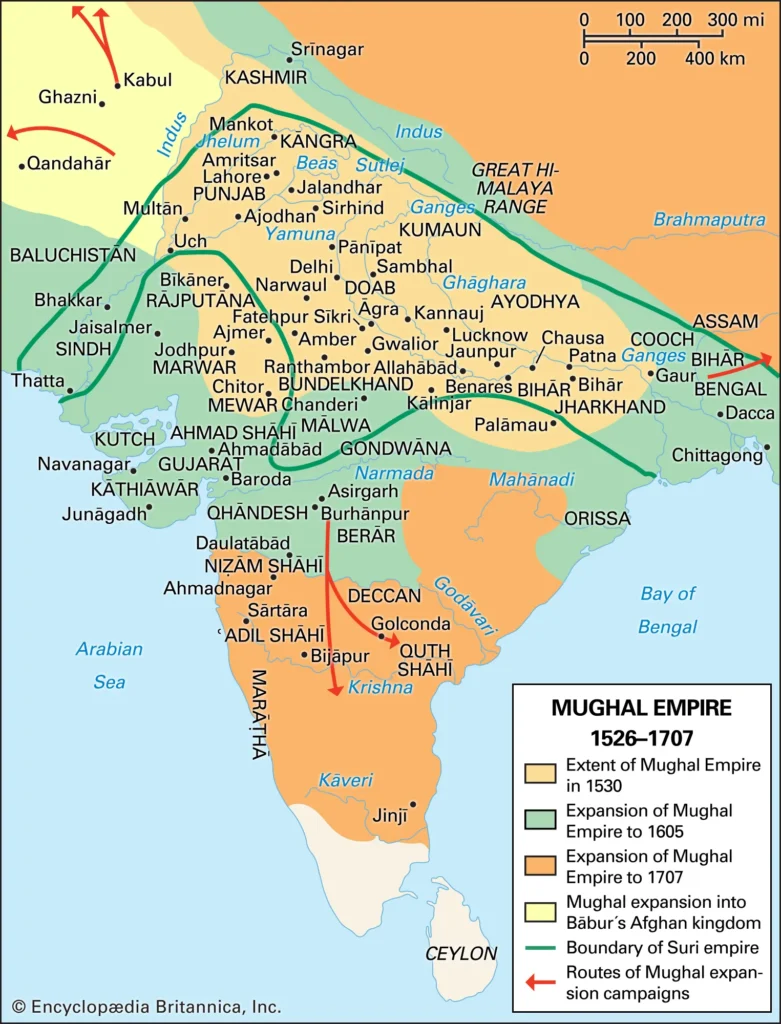
The Mughal Province was one of the most powerful and influential empires in Indian history, ruling large parts of the Indian subcontinent from the early 16th to the mid-19th century. It was founded in 1526 by Babur after his victory over Ibrahim Lodi in the First Battle of Panipat. Babur, a descendant of Timur and Genghis Khan, established a strong foundation for Mughal rule.
The empire expanded significantly under Babur’s successors, especially Akbar (1556–1605), who is considered the greatest Mughal ruler. Akbar strengthened the empire through military conquests, efficient administration, and policies of religious tolerance. He introduced a centralized system of governance and promoted unity among different religious communities, including Hindus and Muslims.
After Akbar, rulers like Jahangir and Shah Jahan continued to maintain the empire’s stability and prosperity. Shah Jahan is best known for building the Taj Mahal, a symbol of love and a masterpiece of Mughal architecture. The Mughal period is often regarded as a golden age of art, culture, and architecture.
The empire reached its greatest territorial extent under Aurangzeb (1658–1707). However, his rule marked the beginning of decline due to continuous wars, heavy taxation, and religious policies that created unrest among his subjects. After his death, the empire weakened due to internal conflicts, succession struggles, and the rise of regional powers like the Marathas.
By the 18th century, the Mughal Province had lost much of its power and became largely symbolic. The arrival of European trading companies, especially the British East India Company, further reduced Mughal authority. The empire officially ended in 1857 after the Indian Rebellion of 1857, when the last Mughal emperor, Bahadur Shah II, was deposed by the British.
In conclusion, the Mughal Empire played a crucial role in shaping India’s history, culture, and architecture. Its legacy can still be seen in monuments, administrative systems, and cultural traditions across the Indian subcontinent.
The Mughal Empire was one of the most powerful and influential empires in the history of India. It was founded in 1526 by Babur after he defeated Ibrahim Lodi in the First Battle of Panipat. Babur was a descendant of Timur and Genghis Khan. With his victory, he established Mughal rule in India, which continued for more than three centuries. The empire played a major role in shaping the political, cultural, and architectural history of the Indian subcontinent.
After Babur, his son Humayun became ruler, but he faced many challenges and temporarily lost the empire. Later, Humayun regained power with Persian support. After him, Akbar became one of the greatest Mughal emperors. Akbar expanded the empire across large parts of India through military victories and wise administration. He introduced policies of religious tolerance, established a strong central government, and encouraged art, culture, and trade. His reign is often considered the golden age of the Mughal Empire.
Akbar was succeeded by Jahangir, who continued many of his father’s policies. Jahangir was known for his interest in justice and art. During his rule, Mughal painting reached new heights. After Jahangir, Shah Jahan became emperor. He is famous for constructing the Taj Mahal in memory of his wife Mumtaz Mahal. The Taj Mahal remains one of the most admired monuments in the world and a symbol of Mughal architectural excellence. Shah Jahan also built many forts, gardens, and palaces.
Aurangzeb was the last major Mughal emperor. He expanded the empire to its greatest territorial size, covering most of the Indian subcontinent. However, his long military campaigns and strict policies weakened the empire financially and politically. After Aurangzeb’s death in 1707, the Mughal Empire began to decline rapidly. Internal conflicts, weak rulers, regional revolts, and foreign invasions reduced Mughal power. Eventually, the British East India Company became dominant in India. The last Mughal emperor, Bahadur Shah II, was removed by the British after the Revolt of 1857.
The Mughal Empire made lasting contributions to India’s culture and society. It promoted a blend of Persian, Indian, and Central Asian traditions. Mughal architecture, including the Taj Mahal, Red Fort, Jama Masjid, and Fatehpur Sikri, remains famous worldwide. The empire also encouraged literature, miniature painting, music, and garden design. Persian became an important language of administration and culture during this time.
In conclusion, the Mughal Empire was a significant chapter in Indian history. It brought political unity to large parts of the country and left a rich cultural legacy. Though it eventually declined, its influence can still be seen in India’s art, architecture, language, and traditions today.