International Big Cat Alliance (IBCA)
What is the International Big Cat Alliance (IBCA)?
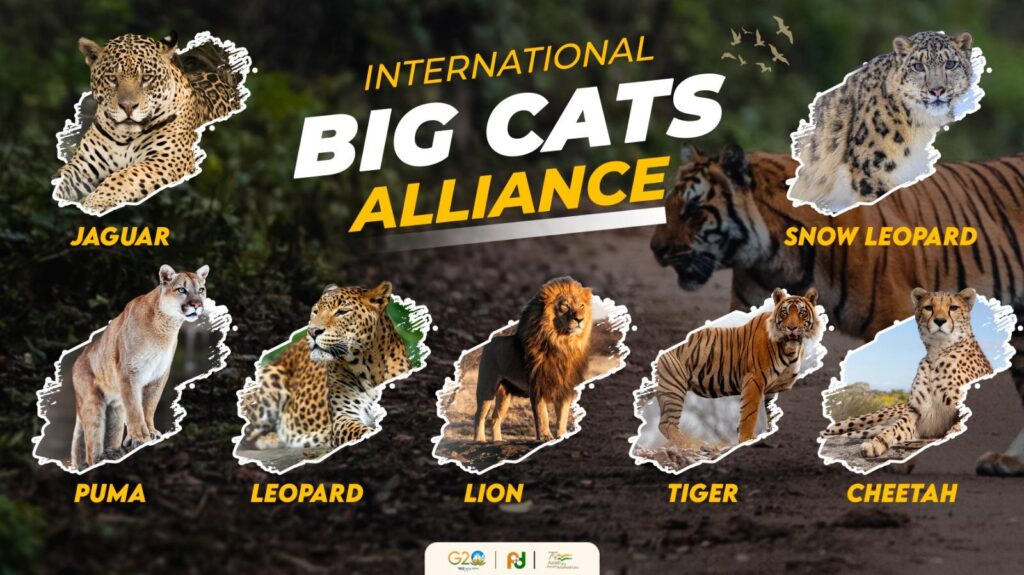
The International Big Cat Alliance (IBCA) is the world’s first treaty-based intergovernmental alliance exclusively dedicated to the conservation of the seven major big cat species across the globe. It aims to strengthen international cooperation in protecting endangered big cats through scientific research, financial support, technology sharing, habitat restoration, and coordinated conservation efforts. It was launched by India in April 2023 and later evolved into a treaty-based international organization with its headquarters in New Delhi.
Launch of IBCA
- Announced by: Prime Minister Narendra Modi
- Launch Date: 9 April 2023
- Occasion: 50 years of Project Tiger
- Launch Venue: Mysuru, Karnataka, India
- Headquarters: New Delhi, India
- Status: Treaty-based intergovernmental organization (effective from 2025).
Objectives of the International Big Cat Alliance
The Alliance aims to:
- Conserve the seven big cat species and their habitats.
- Promote international collaboration among range countries.
- Reduce illegal wildlife trade and poaching.
- Restore degraded ecosystems.
- Improve scientific research and monitoring.
- Share conservation technologies and best practices.
- Build capacity through training and knowledge exchange.
- Mobilize financial resources for conservation.
- Raise public awareness.
- Address climate change impacts on wildlife.
Why Was IBCA Needed?
Despite many conservation programs, challenges remain:
- Illegal wildlife trafficking continues.
- Many countries lack funding.
- Conservation expertise is unevenly distributed.
- Big cats often migrate across borders.
- Climate change affects habitats.
- Human populations increasingly overlap with wildlife.
IBCA provides a common platform to tackle these shared challenges.
Structure of the International Big Cat Alliance (IBCA)
The International Big Cat Alliance (IBCA) has been designed with a robust governance framework to ensure effective international cooperation for the conservation of the world’s seven major big cat species. Its institutional structure promotes transparent decision-making, coordinated implementation, and active participation from member countries. The governance model is inspired by the framework of the International Solar Alliance (ISA), while being tailored specifically for wildlife conservation.
Organizational Structure of the International Big Cat Alliance (IBCA)
                    Assembly (Apex Decision-Making Body)
                                 │
                                 ▼
                     Standing Committee / Council
                                 │
                                 ▼
                    Director-General (Chief Executive)
                                 │
                                 ▼
                           Secretariat
                                 │
         ┌───────────────┬───────────────┬───────────────┐
         │               │               │
 National Focal     Technical &     Research, Finance,
    Points          Scientific      Capacity Building,
                    Cooperation     Outreach & Projects
1. Assembly – Apex Decision-Making Body
The Assembly is the highest governing authority of the International Big Cat Alliance (IBCA). It consists of representatives from all member countries and is responsible for setting the Alliance’s overall vision, policies, and strategic direction.
Composition
- One official representative from each member country.
- Every member country has equal representation.
- The Assembly elects a President for a three-year term to oversee implementation of the Agreement and coordinate the Alliance’s work.
Key Functions
- Determines the long-term strategy of IBCA.
- Admits new member countries and observers.
- Appoints the Director-General.
- Approves annual budgets and financial regulations.
- Adopts work plans and conservation priorities.
- Establishes subsidiary bodies or expert groups when required.
- Reviews progress made by the Alliance.
Meetings
- Meets annually or biennially at the headquarters or another approved venue.
- Special meetings may be convened if required.
- Decisions are generally taken through consensus or according to agreed voting procedures.
2. Standing Committee (Earlier International Steering Committee)
The Standing Committee serves as the executive and supervisory body of the International Big Cat Alliance (IBCA). Before the treaty came into force, an International Steering Committee performed this role; it ceased to exist once the Agreement entered into force and was replaced by the Standing Committee.
Composition
- Comprises a limited number of member countries selected by the Assembly.
- Provides balanced representation across different regions and big cat range countries.
Major Responsibilities
- Implements the decisions of the Assembly.
- Monitors ongoing conservation programmes.
- Reviews financial and administrative performance.
- Coordinates international projects.
- Advises the Assembly on policy matters.
- Oversees emergency conservation initiatives.
The Standing Committee ensures that decisions made at the policy level are effectively translated into action.
3. Director-General (DG)
The Director-General is the chief executive officer of the International Big Cat Alliance (IBCA) and heads the Secretariat.
Appointment
- Appointed by the Assembly.
- Serves for a fixed term under the Framework Agreement.
Responsibilities
- Leads the Secretariat.
- Implements Assembly and Standing Committee decisions.
- Represents IBCA at international meetings.
- Coordinates partnerships with governments, NGOs, research institutions, and funding agencies.
- Supervises staff and manages day-to-day operations.
- Oversees programme execution and reporting.
The Director-General plays a central role in ensuring efficient administration and effective international coordination.
4. Secretariat
The Secretariat is the permanent administrative and operational arm of the International Big Cat Alliance (IBCA).
Headquarters
- New Delhi, India
Primary Functions
- Provides administrative support.
- Organizes Assembly and Standing Committee meetings.
- Coordinates international conservation programmes.
- Manages communication among member countries.
- Maintains databases and documentation.
- Supports research, training, and capacity-building activities.
- Handles finance, human resources, and logistics.
The Secretariat ensures the smooth functioning of the Alliance on a day-to-day basis.
5. National Focal Points
Each member country designates a National Focal Point to act as its official link with the International Big Cat Alliance (IBCA).
Role
- Coordinates national conservation activities.
- Shares information with the Secretariat.
- Facilitates implementation of IBCA programmes.
- Promotes cooperation among government agencies, scientists, and conservation organizations.
- Identifies new collaborative opportunities.
These focal points form a permanent network that strengthens communication between the Alliance and its members.
6. Technical and Scientific Cooperation
Scientific collaboration is a core pillar of the International Big Cat Alliance (IBCA).
The Alliance promotes:
- Wildlife population monitoring.
- Genetic research.
- Habitat assessment.
- Climate resilience studies.
- Disease surveillance.
- Standardized conservation protocols.
- Technology sharing (camera traps, satellite collars, drones, GIS, AI).
This scientific network helps member countries make evidence-based conservation decisions.
7. Finance and Resource Mobilization
The Alliance also has mechanisms to support financial sustainability.
Funding Sources
- Contributions from member countries.
- Initial financial support from India.
- Bilateral and multilateral organizations.
- International donor agencies.
- Corporate Social Responsibility (CSR) initiatives.
- Philanthropic foundations.
Funds are used for:
- Habitat restoration.
- Research projects.
- Capacity building.
- Anti-poaching operations.
- Community conservation programmes.
Decision-Making Process in the International Big Cat Alliance (IBCA)
- Assembly formulates policies, approves budgets, and sets strategic priorities.
- Standing Committee oversees implementation and monitors progress.
- Director-General manages execution of decisions.
- Secretariat carries out operational and administrative work.
- National Focal Points coordinate implementation within member countries and report back to the Secretariat.
This multi-tier governance system ensures accountability, transparency, and effective international collaboration.
Importance of the IBCA Structure
The governance structure of the International Big Cat Alliance (IBCA) is designed to:
- Promote equal participation by all member countries.
- Enable quick and coordinated responses to conservation challenges.
- Improve international information sharing.
- Ensure transparent financial management.
- Strengthen scientific collaboration.
- Support long-term conservation planning.
- Enhance implementation of global biodiversity goals.
Quick Summary Table
Component Main Role Assembly Highest decision-making body; approves policies, budgets, and strategic plans. Standing Committee Supervises implementation and provides strategic oversight. Director-General Chief executive responsible for day-to-day leadership and execution. Secretariat Administrative and operational hub headquartered in New Delhi. National Focal Points Coordinate implementation and communication within member countries. Technical & Scientific Network Supports research, monitoring, technology transfer, and knowledge sharing. Finance & Resource Mechanism Mobilizes and manages resources for conservation programmes.
Membership
Membership is open to:
- Big cat range countries (95 eligible).
- Non-range countries interested in conservation.
- International organizations.
- Scientific institutions.
- Conservation NGOs.
- Corporate and philanthropic partners supporting conservation.
Current Membership (2026)
IBCA continues to expand. As of June 2026, 27 countries are members, with Bangladesh joining as the latest member. Membership is expected to grow further as more range countries join.
Current Affairs on International Big Cat Alliance (IBCA) (2026)
If you’re publishing a blog or current affairs article, include the following recent developments to keep your content up to date and SEO-friendly.
1. Bangladesh Becomes the 27th Member of the International Big Cat Alliance (IBCA)
The biggest recent development is that Bangladesh officially joined the International Big Cat Alliance (IBCA) in June 2026, becoming the 27th member country.
Bangladesh’s membership is significant because the country shares the Sundarbans mangrove ecosystem with India, which supports one of the world’s largest populations of wild Bengal tigers. By joining the Alliance, Bangladesh strengthens regional cooperation on habitat protection, anti-poaching efforts, wildlife monitoring, and transboundary conservation.
This development reflects the growing international acceptance of the International Big Cat Alliance (IBCA) as a global platform for conserving big cats and their ecosystems.
Why it matters
- Membership increased to 27 countries.
- Enhances India–Bangladesh cooperation for tiger conservation.
- Strengthens protection of the Sundarbans ecosystem.
- Promotes information sharing and coordinated wildlife management.
2. India Continues to Lead the International Big Cat Alliance (IBCA)
India remains the driving force behind the International Big Cat Alliance (IBCA). As the host country for the Alliance’s headquarters in New Delhi, India continues to promote global cooperation on conserving the seven big cat species.
India’s experience through initiatives such as Project Tiger, Project Lion, and Project Cheetah has positioned it as a global leader in wildlife conservation. The Alliance serves as a platform for sharing India’s conservation expertise with other range countries.
3. First International Big Cat Alliance (IBCA) Summit
India announced plans to host the first International Big Cat Alliance (IBCA) Summit in New Delhi, bringing together representatives from big cat range countries, scientists, conservation organizations, and policymakers.
The summit is intended to strengthen international collaboration on:
- Wildlife corridor protection
- Anti-poaching cooperation
- Scientific research
- Habitat restoration
- Technology sharing
- Capacity building
Although the summit was initially scheduled for June 2026, it was postponed to a later date. The objectives and international participation remain unchanged.
4. Expansion of Global Cooperation
The International Big Cat Alliance (IBCA) continues to expand its global network by encouraging additional big cat range countries to become members.
The Alliance aims to create a coordinated international response to common conservation challenges such as:
- Illegal wildlife trafficking
- Habitat fragmentation
- Human–wildlife conflict
- Climate change
- Declining prey populations
As membership grows, countries can share research, conservation technologies, and best practices more effectively.
5. Focus on Transboundary Conservation
One of the Alliance’s current priorities is strengthening transboundary conservation, recognizing that many big cat populations move across national borders.
Examples include:
- Bengal tigers in India and Bangladesh
- Snow leopards across the Himalayas
- Leopards and lions in parts of Africa
The Alliance promotes joint monitoring, coordinated anti-poaching operations, and information sharing between neighboring countries.
6. Greater Use of Technology in Conservation
The International Big Cat Alliance (IBCA) is encouraging member countries to adopt modern technologies for wildlife conservation, including:
- Camera traps
- GPS and satellite tracking
- Drones for surveillance
- Artificial intelligence for wildlife monitoring
- DNA-based monitoring
- Geographic Information Systems (GIS)
These tools help improve population estimates, detect poaching, and monitor habitats more efficiently.
7. Growing Importance in Global Biodiversity Conservation
The Alliance is increasingly viewed as a key international initiative supporting global biodiversity goals. By conserving apex predators and their habitats, the International Big Cat Alliance (IBCA) also helps protect forests, grasslands, freshwater ecosystems, and the many species that depend on them.
India’s Role
India is the driving force behind the Alliance because it has:
- Nearly 75% of the world’s wild tigers.
- The only wild Asiatic lions.
- Significant leopard and snow leopard populations.
- Experience from Project Tiger.
- Experience with Project Cheetah.
- Advanced wildlife monitoring systems.
India also provides financial and institutional support for the Alliance.
Major Functions
The Alliance works to:
- Coordinate multinational conservation projects.
- Develop common scientific standards.
- Promote wildlife research.
- Strengthen anti-poaching efforts.
- Improve wildlife law enforcement.
- Support habitat restoration.
- Build wildlife databases.
- Encourage technology transfer.
- Train wildlife professionals.
- Facilitate emergency responses for threatened populations.
Funding
Funding sources include:
- India’s initial budgetary support.
- Member country contributions.
- International organizations.
- Multilateral agencies.
- Philanthropic foundations.
- Corporate social responsibility (CSR) initiatives.
India approved an initial support package of ₹150 crore for the Alliance’s early years.
Benefits of IBCA
For Wildlife
- Better habitat protection.
- Reduced poaching.
- Improved breeding success.
- Greater genetic diversity.
- Stronger ecosystem conservation.
For Countries
- Access to global expertise.
- Improved conservation funding.
- Capacity building.
- Better research collaboration.
- Shared technologies.
For Local Communities
- Sustainable ecotourism.
- Employment opportunities.
- Better human-wildlife conflict management.
- Improved livelihoods linked to conservation.
Importance for Global Biodiversity
Big cats are umbrella species. Conserving them also protects:
- Forests
- Rivers
- Grasslands
- Thousands of plant species
- Hundreds of mammals
- Birds
- Reptiles
- Insects
Protecting big cats therefore supports entire ecosystems.
Major Challenges Facing the International Big Cat Alliance (IBCA)
The success of the International Big Cat Alliance (IBCA) depends on how effectively it addresses the complex threats faced by big cat species across different countries. These challenges involve ecological, economic, political, and social factors that require coordinated international action.
1. Habitat Loss and Fragmentation
Habitat loss is the most significant threat to big cats worldwide. Rapid urbanization, expanding agriculture, mining, road construction, railway projects, dams, and industrial development have led to the destruction and fragmentation of forests, grasslands, and other natural habitats.
When habitats become fragmented, big cat populations become isolated, limiting their movement and reducing opportunities for breeding. This isolation can decrease genetic diversity, making populations more vulnerable to diseases and environmental changes.
For example, tigers require extensive forest landscapes, while snow leopards depend on connected mountain ecosystems. Disrupted habitats also increase encounters between wildlife and humans, leading to conflicts.
IBCA’s Role:
- Promote cross-border wildlife corridors.
- Support habitat restoration projects.
- Encourage sustainable land-use planning.
- Facilitate cooperation among neighboring countries to protect shared ecosystems.
2. Illegal Wildlife Trade and Poaching
Poaching remains one of the most serious threats to big cats. Criminal networks illegally hunt these animals for their skins, bones, claws, teeth, whiskers, and other body parts, which are sold in international black markets.
Despite stricter laws, illegal wildlife trafficking continues due to high profits and weak enforcement in some regions. Big cats are also targeted because of the demand for traditional medicines, luxury products, and trophies.
Poaching affects not only the targeted animals but also disrupts ecosystems by reducing apex predator populations.
IBCA’s Role:
- Strengthen international intelligence sharing.
- Improve border surveillance.
- Support anti-poaching patrols.
- Promote advanced technologies such as drones, satellite monitoring, GPS tracking, and AI-powered wildlife surveillance.
- Enhance cooperation between customs, police, and wildlife authorities.
3. Human–Wildlife Conflict
As human populations expand into wildlife habitats, interactions between people and big cats have become more frequent. Big cats may prey on livestock or enter villages in search of food, leading to economic losses for local communities.
In retaliation, affected communities may kill or injure big cats. Human casualties caused by attacks can also increase negative attitudes toward wildlife conservation.
This conflict is especially common in areas near forests, protected reserves, and agricultural lands.
IBCA’s Role:
- Promote community-based conservation.
- Support fair and timely compensation schemes for livestock losses.
- Develop early warning systems.
- Improve livestock protection measures.
- Encourage eco-tourism and alternative livelihood opportunities that benefit local communities.
4. Climate Change
Climate change is altering ecosystems across the globe, affecting the habitats and prey species of big cats. Rising temperatures, changing rainfall patterns, prolonged droughts, forest fires, and melting glaciers all threaten wildlife.
Snow leopards are particularly vulnerable because warming temperatures are reducing alpine habitats. Similarly, changing vegetation and water availability can affect prey populations, forcing big cats to travel farther in search of food.
Climate change also increases the risk of disease outbreaks and invasive species.
IBCA’s Role:
- Promote climate-resilient conservation planning.
- Support ecosystem restoration.
- Protect climate-sensitive habitats.
- Integrate climate adaptation into wildlife management strategies.
5. Declining Prey Populations
Big cats depend on healthy populations of prey animals such as deer, antelope, wild boar, and mountain ungulates. However, habitat degradation, hunting, and environmental changes have reduced prey availability in many regions.
When prey becomes scarce, big cats are more likely to attack livestock, increasing human-wildlife conflict.
Maintaining balanced ecosystems requires conserving both predators and prey species.
IBCA’s Role:
- Improve prey habitat management.
- Support ecosystem restoration.
- Encourage sustainable wildlife management practices.
- Strengthen monitoring of prey populations.
6. Insufficient Financial Resources
Wildlife conservation is expensive. It requires funding for protected area management, scientific research, ranger salaries, technology, habitat restoration, awareness campaigns, and community development.
Many developing countries that host big cat populations face financial constraints, limiting their conservation efforts.
Without long-term and predictable funding, conservation programs may struggle to achieve lasting results.
IBCA’s Role:
- Mobilize international financial support.
- Encourage contributions from member countries.
- Partner with multilateral organizations, private foundations, and corporate social responsibility (CSR) initiatives.
- Promote innovative financing mechanisms for conservation.
7. Weak Institutional Capacity
Some countries lack sufficient numbers of trained wildlife professionals, forest guards, veterinarians, and conservation scientists. Limited infrastructure, inadequate equipment, and insufficient technical expertise reduce the effectiveness of conservation programs.
Weak institutions also make it difficult to monitor wildlife populations and respond to emerging threats.
IBCA’s Role:
- Organize international training programs.
- Build technical capacity.
- Facilitate knowledge sharing.
- Develop standardized conservation guidelines.
- Support technology transfer between countries.
8. Cross-Border Conservation Challenges
Many big cats, including tigers, snow leopards, leopards, and pumas, move across international borders. Differences in wildlife laws, conservation priorities, and enforcement capacities can hinder coordinated conservation efforts.
Political tensions between neighboring countries may also limit collaboration.
IBCA’s Role:
- Encourage transboundary conservation initiatives.
- Harmonize monitoring methods.
- Facilitate information exchange.
- Promote joint wildlife protection operations.
- Strengthen diplomatic cooperation for conservation.
9. Scientific Data and Monitoring Gaps
Accurate scientific data are essential for effective conservation planning. However, many countries lack reliable information on big cat population sizes, distribution, genetic diversity, habitat quality, and threats.
Limited research capacity can delay conservation decisions and reduce program effectiveness.
IBCA’s Role:
- Promote collaborative research.
- Support wildlife population surveys.
- Encourage use of camera traps, satellite collars, drones, environmental DNA (eDNA), and GIS-based monitoring.
- Develop shared databases for member countries.
10. Balancing Development with Conservation
Governments must often balance economic development with environmental protection. Infrastructure projects such as highways, railways, hydropower dams, mining operations, and urban expansion can threaten wildlife habitats if not carefully planned.
Finding sustainable solutions that support both development and biodiversity conservation remains a major challenge.
IBCA’s Role:
- Advocate for environmentally responsible development.
- Encourage wildlife-friendly infrastructure, including overpasses and underpasses.
- Promote strategic environmental impact assessments.
- Integrate biodiversity conservation into national development policies.
11. Emerging Diseases and Health Risks
Wildlife populations are increasingly vulnerable to diseases that can spread from domestic animals or humans. Outbreaks of diseases such as canine distemper virus or bovine tuberculosis have affected wild carnivores in some regions.
Disease surveillance and veterinary support are therefore becoming more important components of conservation.
IBCA’s Role:
- Strengthen wildlife health monitoring.
- Promote a One Health approach that recognizes the links between human, animal, and environmental health.
- Support disease surveillance and emergency response systems.
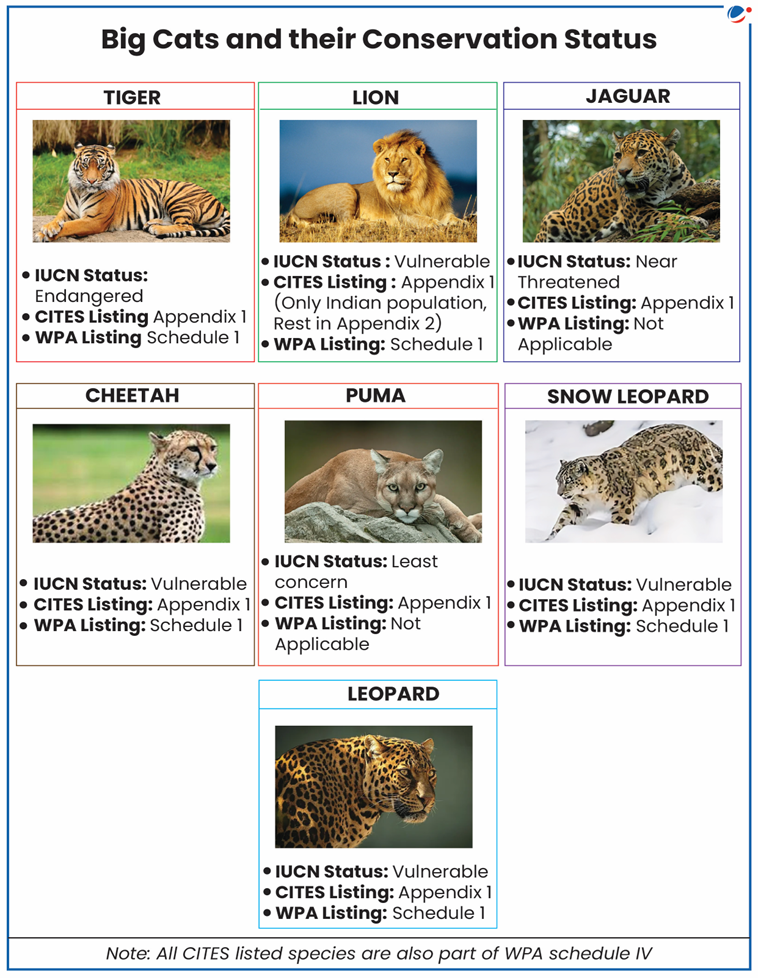
The Seven Big Cats Covered by IBCA
| Big Cat | Scientific Name | Conservation Status |
|---|---|---|
| Tiger | Panthera tigris | Endangered |
| Lion | Panthera leo | Vulnerable |
| Leopard | Panthera pardus | Vulnerable |
| Snow Leopard | Panthera uncia | Vulnerable |
| Cheetah | Acinonyx jubatus | Vulnerable |
| Jaguar | Panthera onca | Near Threatened |
| Puma (Cougar) | Puma concolor | Least Concern (globally, with regional threats) |
India is home to five of these seven species: tiger, lion, leopard, snow leopard, and cheetah (reintroduced).
Future Roadmap
IBCA aims to:
- Expand global membership.
- Increase funding for conservation.
- Develop advanced monitoring technologies (AI, drones, satellite tracking).
- Strengthen cross-border wildlife corridors.
- Enhance research collaborations.
- Promote community-based conservation.
- Improve anti-poaching intelligence sharing.
- Integrate climate adaptation into wildlife conservation.
Conclusion
The International Big Cat Alliance is a landmark initiative in global wildlife conservation. By bringing together governments, scientists, conservation organizations, and local communities, it provides a coordinated platform to protect the world’s seven iconic big cat species. India’s leadership, combined with international cooperation, has the potential to strengthen biodiversity conservation, combat wildlife crime, and safeguard ecosystems for future generations.