
Central Industrial Security Force (CISF)
What is CISF?
The Central Industrial Security Force (CISF) is one of India’s Central Armed Police Forces (CAPF) under the control of the Ministry of Home Affairs.
Key Facts About CISF
- Full Form: Central Industrial Security Force
- Established: 10 March 1969
- Headquarters: New Delhi
- Ministry: Ministry of Home Affairs (MHA)
- Motto: Protection and Security
Main Functions of CISF
The CISF is responsible for providing security to:
- Airports across India.
- Seaports and Metro Rail Networks.
- Nuclear and Space Installations.
- Public Sector Undertakings (PSUs) such as steel plants, power plants, and oil refineries.
- Important government buildings and critical infrastructure.
- Disaster management and fire protection services in certain establishments.
Roles and Responsibilities
- Industrial security
- Aviation security
- VIP security
- Disaster response
- Counter-terrorism support
- Access control and surveillance at strategic installations
Organizational Structure
The CISF is headed by a Director General (DG), usually an officer from the Indian Police Service (IPS). The force has specialized units for airport security, fire services, and rapid response operations.
Why is CISF Important?
India’s economy depends on critical infrastructure such as airports, power plants, oil refineries, and metro systems. The CISF safeguards these vital assets against threats including terrorism, sabotage, theft, and other security risks.
As of recent years, the CISF has grown to over 1.7 lakh personnel, making it one of the largest security forces dedicated to protecting critical infrastructure in the world.
Establishment and Evolution of CISF
• CISF was established in 1969 under the provisions of the CISF Act, 1968.
• At the time of its creation, it had a sanctioned strength of only three battalions.
• Its original objective was to provide security to selected sensitive Public Sector
Undertakings (PSUs).
• In 1983, the CISF Act was amended and CISF was officially declared an Armed Force of the
Union.
• Over time, the force expanded significantly in size and responsibilities.
• Today, CISF has a strength of more than 1.88 lakh (188,000+) personnel and has become a
highly specialized multi-skilled security organization.
Organisation Structure of CISF
Leadership
• CISF is headed by a Director-General (DG), who is an officer of the Indian Police Service
(IPS).
• The DG is assisted by an Additional Director-General (ADG), also from the IPS.
Sectors of CISF
• The force is divided into seven sectors:
o Airport Sector
o North Sector
o North-East Sector
o East Sector
o West Sector
o South Sector
o Training Sector
• CISF also has a dedicated Fire Service Wing.
Training Institutions
• CISF has seven training institutions.
• These include:
o Six Recruit Training Centres (RTCs)
o National Industrial Security Academy (NISA)
• These institutions train personnel in security operations, disaster management, fire protection,
VIP security, and industrial security.
What Makes CISF Unique?
Compensatory Cost Force
• CISF is known as a Compensatory Cost Force.
• This means it charges its client organizations for the security services it provides.
• The cost of deployment is borne by the organization receiving CISF protection.
Only CAPF with Daily Public Interface
• CISF is the only Central Armed Police Force that interacts with the public on a daily basis.
• Citizens regularly encounter CISF personnel at:
o Airports
o Delhi Metro
o Heritage monuments
o Various public infrastructure facilities
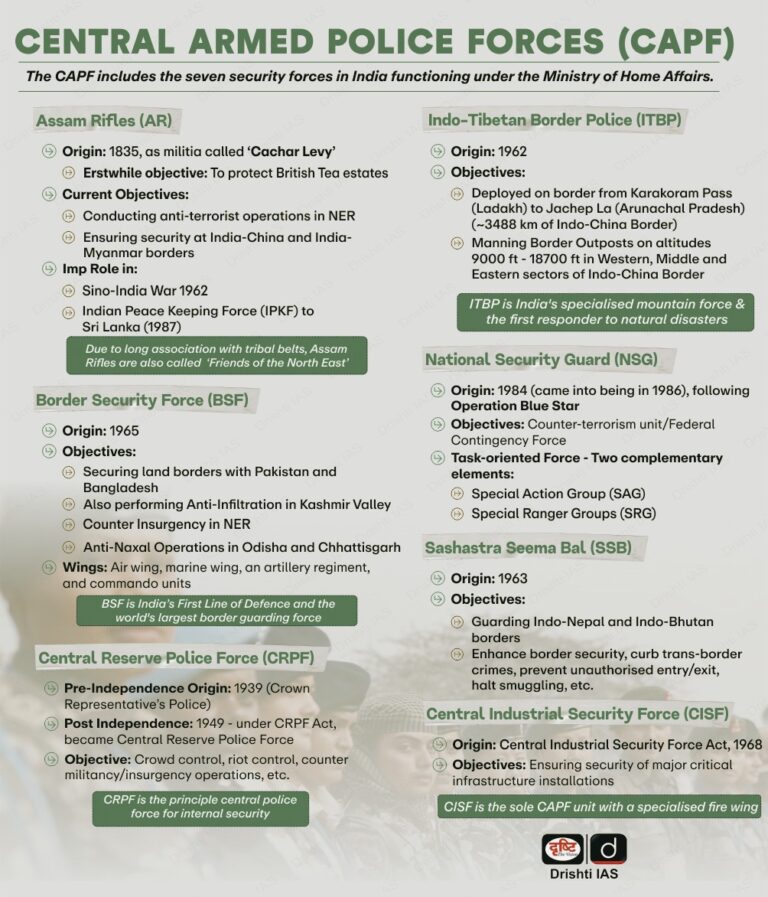
CAPF (Central Armed Police Forces): Complete Guide
Introduction to CAPF
The Central Armed Police Forces (CAPF) are a group of security forces under the Ministry of Home Affairs responsible for maintaining internal security, guarding borders, combating terrorism, controlling riots, and protecting vital installations across India. CAPFs play a crucial role in ensuring national security and supporting state police forces during emergencies.
India has seven major Central Armed Police Forces, each with specialized responsibilities and operational areas.
What is CAPF?
CAPF stands for Central Armed Police Forces. These forces are centrally controlled by the Government of India and operate under the Ministry of Home Affairs. They are distinct from the Indian Armed Forces, which are responsible for defending the country against external military threats.
The CAPFs are deployed for border management, counter-insurgency operations, anti-terrorism activities, election duties, disaster management, VIP security, and protection of strategic assets.
History of CAPF
The origins of CAPFs date back to the colonial era. Over time, various forces were established to meet India’s evolving security requirements. Following independence, these forces were reorganized and expanded to address challenges such as border security, insurgencies, terrorism, and industrial protection.
Today, CAPFs form one of the largest security networks in the world, with several lakh personnel serving across the country.
Forces Under CAPF
1. Central Reserve Police Force (CRPF)
Established: 1939
The CRPF is the largest CAPF in India and serves as the primary force for maintaining internal security.
Key Responsibilities:
- Counter-insurgency operations
- Anti-Naxal operations
- Riot control
- Election security
- Law and order maintenance
- Assistance to state police forces
The CRPF is deployed extensively in areas affected by left-wing extremism and insurgency.
2. Border Security Force (BSF)
Established: 1965
The BSF is India’s first line of defense on the international borders with Pakistan and Bangladesh.
Key Responsibilities:
- Border guarding
- Prevention of smuggling
- Detection of illegal infiltration
- Intelligence gathering
- Wartime support to the Army
The BSF is often called the “Sentinels of India’s Borders.”
3. Central Industrial Security Force (CISF)
Established: 1969
The CISF is responsible for protecting critical infrastructure and industrial establishments.
Key Responsibilities:
- Airport security
- Metro security
- Protection of nuclear and space facilities
- Security of government buildings
- Industrial security management
The CISF secures hundreds of important installations throughout India.
4. Indo-Tibetan Border Police (ITBP)
Established: 1962
The ITBP guards the India-China border in the Himalayan region.
Key Responsibilities:
- Border surveillance
- High-altitude warfare preparedness
- Disaster response
- Mountain rescue operations
- Security in remote border areas
ITBP personnel are specially trained for extreme weather and high-altitude conditions.
5. Sashastra Seema Bal (SSB)
Established: 1963
The SSB guards India’s borders with Nepal and Bhutan.
Key Responsibilities:
- Border management
- Prevention of cross-border crime
- Intelligence collection
- Community engagement in border villages
The force maintains peaceful and secure borders while fostering cooperation with local communities.
6. Assam Rifles (Northeast India)
Established: 1835
The Assam Rifles is the oldest paramilitary force in India.
Key Responsibilities:
- Counter-insurgency operations
- Border security along the India-Myanmar border
- Assistance in maintaining law and order
- Civic action programs
It plays a vital role in maintaining peace in the northeastern region.
7. National Security Guard (NSG)
Established: 1984
The NSG is India’s elite counter-terrorism force, popularly known as the “Black Cats.”
Key Responsibilities:
- Counter-terrorism operations
- Hostage rescue
- Bomb disposal
- Anti-hijacking operations
- Special intervention missions
NSG personnel undergo rigorous training and are deployed during high-risk security situations.
Importance of CAPF
The Central Armed Police Forces are essential for:
- Protecting India’s borders
- Fighting terrorism and insurgency
- Maintaining internal security
- Securing critical infrastructure
- Assisting during natural disasters
- Conducting election duties
- Supporting state police forces
Without CAPFs, maintaining security across India’s vast geographical and strategic landscape would be extremely difficult.
CAPF Recruitment
Recruitment to CAPFs is conducted through various examinations organized by the Staff Selection Commission (SSC) and the Union Public Service Commission (UPSC).
Major Recruitment Exams
- CAPF Assistant Commandant Examination (UPSC)
- SSC GD Constable Examination
- SSC CPO Examination
- Departmental Recruitment Processes
Candidates undergo written examinations, physical efficiency tests, medical examinations, and interviews depending on the post.
Challenges Faced by CAPF
1. Terrorism
CAPFs continuously combat terrorist threats across various regions.
2. Border Infiltration
Illegal migration and smuggling remain major concerns.
3. Left-Wing Extremism
Naxal-affected regions require sustained security operations.
4. Difficult Terrain
Personnel often operate in deserts, mountains, forests, and remote border areas.
5. Cyber and Emerging Threats
Modern security challenges require advanced technological capabilities.
Modernization of CAPF
The Government of India is continuously modernizing CAPFs through:
- Advanced surveillance systems
- Drone technology
- Smart border fencing
- Modern communication networks
- Better protective equipment
- Specialized counter-terrorism training
These initiatives enhance operational effectiveness and national security.
Conclusion
The Central Armed Police Forces (CAPF) form the backbone of India’s internal security architecture. Whether guarding borders, securing airports, combating terrorism, protecting industrial infrastructure, or maintaining law and order, CAPFs contribute significantly to the safety and stability of the nation. Their dedication, discipline, and sacrifice ensure that India’s citizens and critical assets remain protected against a wide range of security threats.