
What is Polity?
Polity refers to the system of government, political institutions, laws, constitution, and administrative structure of a country. In the Indian context, polity mainly focuses on the Constitution of India, Parliament, Judiciary, Executive, Fundamental Rights, Directive Principles, Elections, and Local Government.
Indian polity is based on democratic principles where people elect their representatives through free and fair elections. India follows a parliamentary system of government with a federal structure and unitary features.
Importance of Polity in Competitive Exams
Polity is considered a scoring subject because most questions are factual and concept-based. If studied properly, students can solve questions accurately in less time. It is commonly asked in:
- UPSC Civil Services Examination
- SSC CGL, CHSL, MTS
- Banking Exams
- Railway Recruitment Exams
- State PSC Exams
- Defence Exams
Questions may be based on constitutional articles, amendments, schedules, rights, duties, parliament functions, and governance systems.
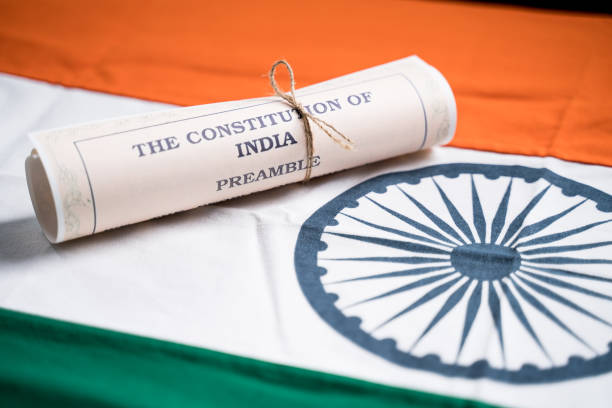
Constitution of India
The Constitution of India is the supreme law of the country. It came into effect on 26 January 1950, celebrated as Republic Day. It defines the powers of the government, rights of citizens, and duties of institutions.
Key Features of Indian Constitution
- Longest written constitution in the world
- Parliamentary system of government
- Federal structure with unitary bias
- Fundamental Rights
- Directive Principles of State Policy
- Independent Judiciary
- Secular State
- Universal Adult Franchise
- Single Citizenship
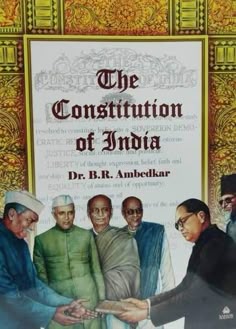
Preamble of India
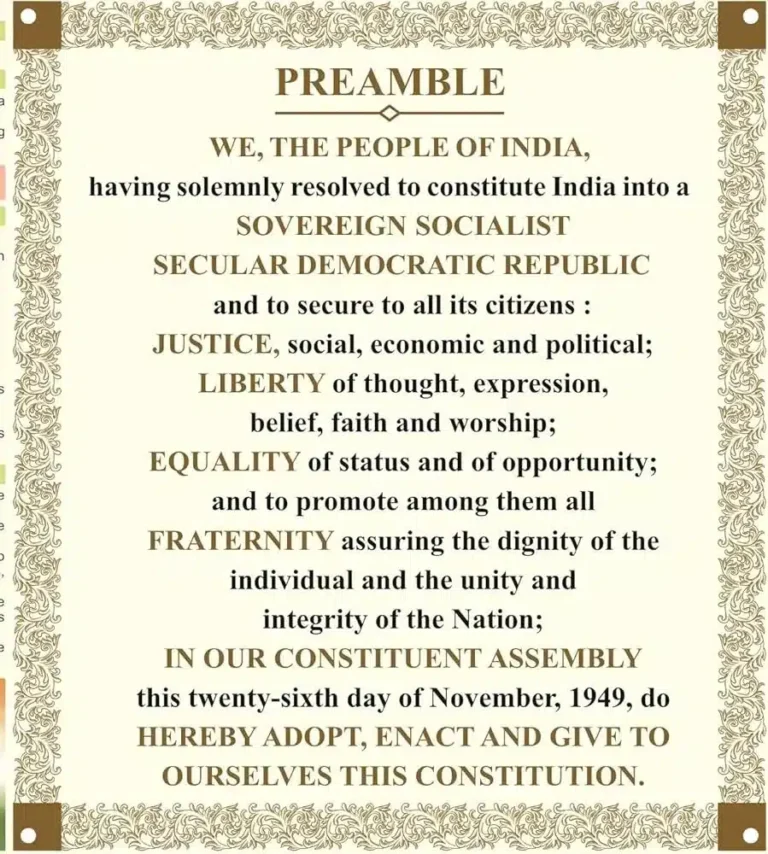
The Preamble is the introduction of the Constitution. It declares India as a Sovereign, Socialist, Secular, Democratic Republic and assures justice, liberty, equality, and fraternity to all citizens.
Indian Preamble – Meaning, Features and Importance
The Preamble of the Indian Constitution is the introductory statement of the Constitution that reflects the ideals, objectives, and philosophy of the nation. It is often called the soul of the Constitution because it describes the purpose of the Constitution and the values on which India is built.
The Preamble was adopted on 26 November 1949 and came into force on 26 January 1950, the day India became a Republic.
Text of the Indian Preamble
“We, the people of India, having solemnly resolved to constitute India into a Sovereign Socialist Secular Democratic Republic and to secure to all its citizens:
- Justice – social, economic and political
- Liberty – of thought, expression, belief, faith and worship
- Equality – of status and opportunity
- Fraternity – assuring the dignity of the individual and the unity and integrity of the Nation
In our Constituent Assembly this twenty-sixth day of November 1949, do hereby adopt, enact and give to ourselves this Constitution.”
Meaning of Key Words in the Preamble
1. We, the People of India
This means the Constitution gets its authority from the people of India.
2. Sovereign
India is independent and free to make its own decisions in internal and external matters.
3. Socialist
India aims to reduce inequality and promote social and economic justice.
4. Secular
India has no official religion and respects all religions equally.
5. Democratic
The government is elected by the people through free and fair elections.
6. Republic
The head of the state (President) is elected, not hereditary.
Objectives of the Preamble
The Preamble secures the following values for citizens:
Justice
Equal treatment in social, economic, and political life.
Liberty
Freedom of thought, speech, belief, faith, and worship.
Equality
Equal status and equal opportunity for every citizen.
Fraternity
Brotherhood among citizens ensuring unity and dignity.
Importance of the Preamble
- It explains the source of authority of the Constitution.
- It states the ideals and goals of the Indian state.
- It helps in interpreting the Constitution.
- It reflects the vision of the makers of the Constitution.
- It promotes national unity and integrity.
Amendment in the Preamble
The 42nd Constitutional Amendment Act, 1976 added three words:
- Socialist
- Secular
- Integrity
Preamble and Supreme Court
In the Kesavananda Bharati Case (1973), the Supreme Court held that the Preamble is a part of the Constitution and can be used to understand its basic structure.
Important for Competitive Exams
Questions are often asked on:
- Date of adoption of Preamble
- Words added by 42nd Amendment
- Keywords like Sovereign, Secular, Republic
- Ideals: Justice, Liberty, Equality, Fraternity
Conclusion
The Indian Preamble is the guiding light of the Constitution. It represents the dreams, values, and aspirations of the people of India. Understanding the Preamble is essential for every citizen and highly important for competitive exam preparation.
Fundamental Rights
Fundamental Rights are guaranteed to citizens for their freedom and protection. These rights are enforceable by courts.
Types of Fundamental Rights
- Right to Equality
- Right to Freedom
- Right against Exploitation
- Right to Freedom of Religion
- Cultural and Educational Rights
- Right to Constitutional Remedies
These rights are very important for exam preparation.
Fundamental Duties
Fundamental Duties were added by the 42nd Constitutional Amendment in 1976. They remind citizens about their responsibilities toward the nation, constitution, environment, and unity of India.
Directive Principles of State Policy
These are guidelines for the government to establish social and economic justice. They are not enforceable in court but are important for governance.
Examples include:
- Equal pay for equal work
- Promotion of education
- Protection of environment
- Welfare of people
President of India
The President is the constitutional head of the country. All executive powers are vested in the President, but these are exercised on the advice of the Prime Minister and Council of Ministers.
Key Points
- Elected indirectly
- Term of 5 years
- Supreme Commander of Armed Forces
Prime Minister
The Prime Minister is the real executive head of the government. The PM leads the Council of Ministers and manages administration.
Parliament of India
Parliament is the legislative body of India. It consists of:
- President
- Lok Sabha
- Rajya Sabha
Functions of Parliament
- Making laws
- Passing budget
- Discussing national issues
- Controlling executive
Judiciary
The judiciary protects the Constitution and ensures justice. The Supreme Court is the highest court in India.
Functions of Judiciary
- Judicial Review
- Protection of Rights
- Interpretation of Constitution
- Settlement of disputes
State Government
Each state has its own government with:
- Governor
- Chief Minister
- State Legislature
The Chief Minister is the real executive head of the state.
Local Government
Local self-government strengthens democracy at grassroots level.
Rural Areas
- Gram Panchayat
- Panchayat Samiti
- Zila Parishad
Urban Areas
- Municipal Corporation
- Municipality
- Nagar Panchayat
Election Commission
The Election Commission of India conducts free and fair elections for Parliament, State Legislatures, and offices of President and Vice-President.