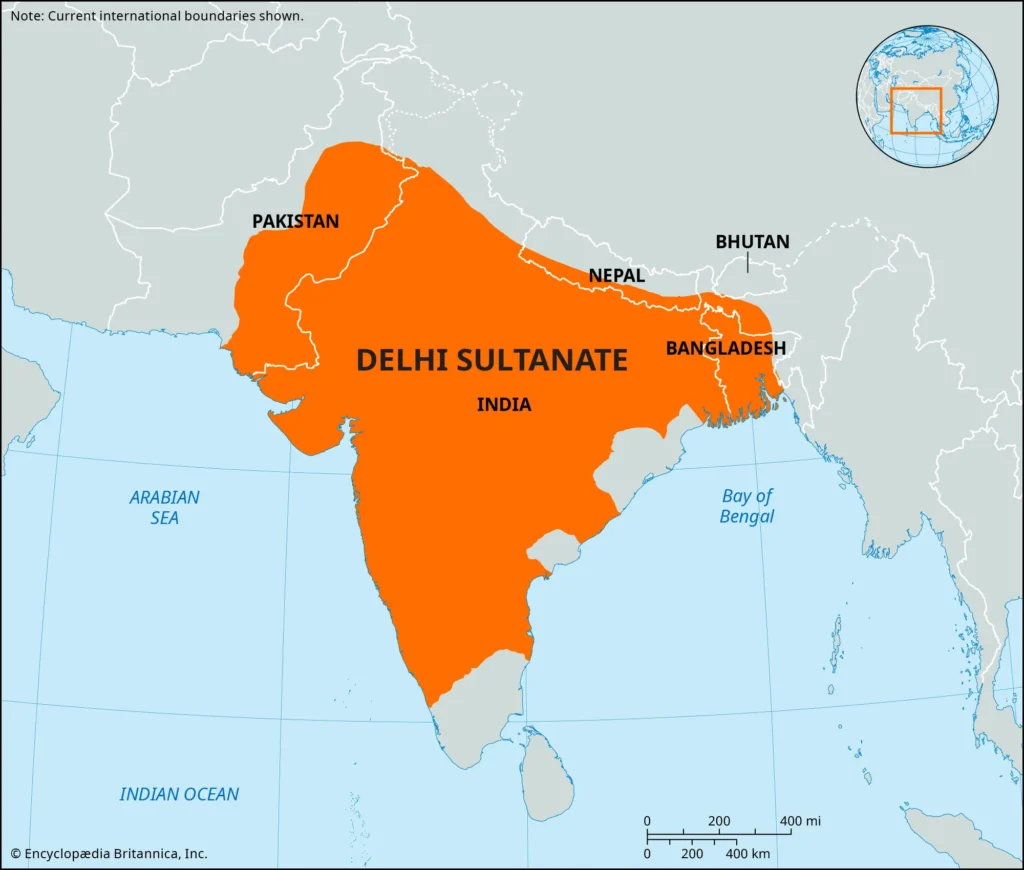
Delhi Sultanate (1206-1526)
Delhi Sultanate : History, Dynasties and Major Rulers
The Delhi Sultanate was one of the most significant political and cultural periods in medieval Indian history. It ruled large parts of the Indian subcontinent from 1206 to 1526 and laid the foundation for centralized Islamic rule in northern India. The Delhi Sultanate played a major role in shaping India’s political structure, architecture, military systems, and cultural development.
The period of the Delhi Sultanate began after the defeat of Prithviraj Chauhan by Muhammad Ghori in the Second Battle of Tarain in 1192. Although Muhammad Ghori did not establish permanent rule in India himself, his general Qutb-ud-din Aibak laid the foundation of the Delhi Sultanate after Ghori’s death.
Origin of the Delhi Sultanate
The establishment of the Delhi Sultanate marked the beginning of Muslim rule over much of northern India. In 1206, Qutb-ud-din Aibak became the first ruler of the Sultanate and founded the Mamluk or Slave Dynasty. Delhi became the center of political power, and over time the Sultanate expanded across large parts of India.
The Delhi Sultanate lasted for more than three centuries and was ruled by five major dynasties:
- Mamluk (Slave) Dynasty
- Khilji Dynasty
- Tughlaq Dynasty
- Sayyid Dynasty
- Lodi Dynasty
Delhi Sultanate:Mamluk Dynasty (1206–1290)
Mamluk Dynasty: History, Rulers and Key Contributions
The Mamluk Dynasty was the first ruling dynasty of the Delhi Sultanate and governed northern India from 1206 to 1290. Founded by Qutb-ud-din Aibak, the Mamluk Dynasty laid the foundation of Muslim rule in India and established Delhi as the political center of power.
The Mamluk Dynasty is also known as the Slave Dynasty because many of its rulers were former slaves who rose to positions of military and political power.
Origin of the Mamluk Dynasty
The Mamluk Dynasty was established in 1206 after the death of Muhammad Ghori. His trusted general Qutb-ud-din Aibak declared independence and founded the first dynasty of the Delhi Sultanate.
The word “Mamluk” means “owned” or “slave,” referring to the military slave origins of many rulers of the Mamluk Dynasty.
Major Rulers of the Mamluk Dynasty
The Mamluk Dynasty had several notable rulers:
- Qutb-ud-din Aibak
- Iltutmish
- Razia Sultan
- Ghiyas ud din Balban
Qutb-ud-din Aibak (1206–1210)
Qutb-ud-din Aibak founded the Mamluk Dynasty and became the first Sultan of Delhi.
Achievements
- Established Delhi Sultanate
- Began construction of Qutub Minar
- Consolidated Turkish rule in India
- Expanded administrative control
Iltutmish (1211–1236)
Iltutmish was the most important ruler of the Mamluk Dynasty. He firmly established the Sultanate and expanded its territory.
Contributions
- Secured Delhi against rivals
- Introduced silver tanka currency
- Organized the iqta system
- Completed Qutub Minar construction
Razia Sultan (1236–1240)
Razia Sultan was the only female ruler of the Mamluk Dynasty and one of the most remarkable rulers in Indian history.
Importance
- First woman to rule Delhi
- Promoted merit over nobility
- Strengthened royal authority
Balban (1266–1287)
Balban was one of the strongest rulers of the Mamluk Dynasty.
Key Reforms
- Strengthened monarchy
- Introduced strict court discipline
- Crushed rebellions
- Improved military organization
Administration of the Mamluk Dynasty
The Mamluk Dynasty established an effective administrative framework.
Features
- Centralized monarchy
- Provincial administration through iqta system
- Military-based governance
- Revenue collection through appointed officers
Economy Under the Mamluk Dynasty
The Mamluk Dynasty relied heavily on agricultural taxation.
Economic Features
- Land revenue as main income
- Standardized coinage
- Expansion of trade routes
- Growth of urban centers
Architecture of the Mamluk Dynasty
The Mamluk Dynasty contributed significantly to Indo-Islamic architecture.
Major Monuments
- Qutub Minar
- Quwwat-ul-Islam Mosque
- Sultan Ghari Tomb
Architectural features included:
- Arches
- Domes
- Red sandstone construction
Decline of the Mamluk Dynasty
The Mamluk Dynasty declined after Balban’s death due to weak successors and internal conflicts.
Reasons for Decline
- Succession disputes
- Weak rulers after Balban
- Noble conspiracies
- Rise of Jalaluddin Khilji
In 1290, the Mamluk Dynasty ended when Jalaluddin Khilji founded the Khilji Dynasty.
Legacy of the Mamluk Dynasty
The Mamluk Dynasty laid the foundation for later Delhi Sultanate rulers.
Contributions
- Established stable Muslim rule in India
- Introduced administrative reforms
- Promoted Indo-Islamic architecture
- Strengthened Delhi as political capital
Conclusion
The Mamluk Dynasty was a foundational period in medieval Indian history. As the first dynasty of the Delhi Sultanate, it created the administrative, military, and architectural framework for future rulers. The legacy of the Mamluk Dynasty remains visible in India’s monuments and political history.
Delhi Sultanate :Khilji Dynasty (1290–1320)
Khilji Dynasty: History, Rulers and Major Achievements
The Khilji Dynasty was the second ruling dynasty of the Delhi Sultanate and governed northern India from 1290 to 1320. The dynasty is remembered for military expansion, economic reforms, and administrative innovations. Under the Khilji rulers, especially Alauddin Khilji, the Delhi Sultanate reached new heights of territorial power.
The Khilji Dynasty played a major role in strengthening the political and military foundations of medieval India.
Origin of the Khilji Dynasty
The Khilji Dynasty was founded in 1290 by Jalaluddin Khilji after overthrowing the last ruler of the Mamluk Dynasty. This marked the transfer of power from Turkish nobles to the Khilji faction.
The rise of the Khilji Dynasty reflected changing power dynamics within the Delhi Sultanate.
Major Rulers of the Khilji Dynasty
The principal rulers of the Khilji Dynasty were:
- Jalaluddin Khilji
- Alauddin Khilji
- Qutbuddin Mubarak Shah
Jalaluddin Khilji (1290–1296)
Jalaluddin Khilji founded the Khilji Dynasty and established its authority over Delhi.
Achievements
- Ended Mamluk rule
- Consolidated political control
- Adopted moderate policies
- Expanded initial territories
Alauddin Khilji (1296–1316)
Alauddin Khilji was the greatest ruler of the Khilji Dynasty.
Major Achievements
- Expanded empire into Gujarat, Rajasthan, and Deccan
- Defeated Mongol invasions
- Introduced market reforms
- Strengthened military administration
His reign represented the golden age of the Khilji Dynasty.
Military Expansion Under the Khilji Dynasty
The Khilji Dynasty greatly expanded the Delhi Sultanate through successful military campaigns.
Key Conquests
- Gujarat
- Ranthambore
- Chittor
- Malwa
- Deccan territories
Administrative Reforms of the Khilji Dynasty
The Khilji Dynasty introduced several reforms to strengthen governance.
Important Reforms
- Strict revenue collection
- Centralized administration
- Spy network expansion
- Noble control measures
Economic Reforms Under Alauddin Khilji
One of the greatest achievements of the Khilji Dynasty was its market reform system.
Market Reforms Included
- Price controls on goods
- Regulation of grain markets
- Standardized weights and measures
- Monitoring of traders
These reforms helped maintain military efficiency and economic stability.
Architecture of the Khilji Dynasty
The Khilji Dynasty contributed to Indo-Islamic architecture.
Notable Monuments
- Alai Darwaza
- Siri Fort
- Hauz Khas reservoir
Decline of the Khilji Dynasty
The Khilji Dynasty declined after Alauddin Khilji’s death.
Reasons for Decline
- Weak successors
- Court conspiracies
- Noble rebellions
- Administrative instability
In 1320, Ghiyasuddin Tughlaq ended the Khilji Dynasty and founded the Tughlaq Dynasty.
Legacy of the Khilji Dynasty
The Khilji Dynasty left a lasting mark on Indian history.
Contributions
- Expanded Delhi Sultanate to greatest extent
- Defended India from Mongol invasions
- Introduced advanced market regulations
- Strengthened military organization
Conclusion
The Khilji Dynasty was one of the most powerful dynasties of the Delhi Sultanate. Through military expansion, economic reforms, and administrative centralization, the Khilji rulers transformed the Sultanate into a dominant empire. The achievements of the Khilji Dynasty remain a vital part of medieval Indian history.
Delhi Sultanate: Tughlaq Dynasty (1320 to 1414)
Tughlaq Dynasty: History, Rulers and Key Achievements
The Tughlaq Dynasty was the third ruling dynasty of the Delhi Sultanate and governed much of northern India from 1320 to 1414. Founded by Ghiyasuddin Tughlaq, the dynasty is remembered for territorial expansion, ambitious administrative experiments, architectural achievements, and eventual decline.
The Tughlaq Dynasty played a major role in shaping medieval Indian governance and infrastructure.
Origin of the Tughlaq Dynasty
The Tughlaq Dynasty was established in 1320 when Ghiyasuddin Tughlaq overthrew the last Khilji ruler and took control of Delhi.
The rise of the Tughlaq Dynasty marked a new phase of expansion and administrative restructuring in the Delhi Sultanate.
Major Rulers of the Tughlaq Dynasty
The principal rulers of the Tughlaq Dynasty were:
- Ghiyasuddin Tughlaq
- Muhammad bin Tughlaq
- Firoz Shah Tughlaq
Ghiyasuddin Tughlaq (1320–1325)
Ghiyasuddin Tughlaq founded the Tughlaq Dynasty and strengthened the Delhi Sultanate.
Achievements
- Established the Tughlaq Dynasty
- Restored law and order
- Expanded territorial control
- Built Tughlaqabad Fort
Muhammad bin Tughlaq (1325–1351)
Muhammad bin Tughlaq was one of the most controversial rulers of the Tughlaq Dynasty.
Major Policies
- Shifted capital from Delhi to Daulatabad
- Introduced token currency
- Planned expansion into Central Asia
- Increased taxation in the Doab region
Though innovative, many policies failed and weakened the Tughlaq Dynasty.
Firoz Shah Tughlaq (1351–1388)
Firoz Shah Tughlaq focused on welfare and infrastructure.
Contributions
- Built canals for irrigation
- Established schools and hospitals
- Constructed cities and monuments
- Reduced harsh taxation
His reign stabilized the Tughlaq Dynasty temporarily.
Administration of the Tughlaq Dynasty
The Tughlaq Dynasty introduced administrative reforms to improve governance.
Key Features
- Provincial governance system
- Revenue administration reforms
- Military expansion
- Public welfare institutions
Architecture of the Tughlaq Dynasty
The Tughlaq Dynasty developed a unique style of architecture.
Major Monuments
- Tughlaqabad Fort
- Firoz Shah Kotla
- Tomb of Ghiyasuddin Tughlaq
Architectural Features
- Sloping walls
- Massive fortifications
- Simplicity in decoration
- Strong military design
Decline of the Tughlaq Dynasty
The Tughlaq Dynasty weakened after Firoz Shah’s death.
Reasons for Decline
- Weak successors
- Provincial revolts
- Economic instability
- Timur’s invasion in 1398
- Administrative collapse
The Tughlaq Dynasty officially ended in 1414.
Legacy of the Tughlaq Dynasty
The Tughlaq Dynasty left a strong impact on Indian history.
Contributions
- Administrative experiments
- Architectural innovation
- Infrastructure development
- Expansion of Sultanate territory
Conclusion
The Tughlaq Dynasty was one of the most influential dynasties of the Delhi Sultanate. Its rulers introduced bold reforms, built major architectural landmarks, and expanded administrative institutions. Despite its eventual decline, the Tughlaq Dynasty remains an important chapter in medieval Indian history.
Delhi Sultanate:Sayyid Dynasty (1414 to 1451)
Sayyid Dynasty: History, Rulers and Key Contributions
The Sayyid Dynasty was the fourth ruling dynasty of the Delhi Sultanate and governed northern India from 1414 to 1451. Founded by Khizr Khan, the dynasty ruled during a period of political fragmentation and declining central authority after Timur’s devastating invasion of India in 1398.
The Sayyid Dynasty is remembered for preserving the Delhi Sultanate during one of its weakest phases.
Origin of the Sayyid Dynasty
The Sayyid Dynasty was established in 1414 by Khizr Khan after he captured Delhi and ended the Tughlaq Dynasty. Khizr Khan had been appointed governor of Multan by Timur and later took control of Delhi.
The formation of the Sayyid Dynasty marked an attempt to restore political stability after years of chaos.
Major Rulers of the Sayyid Dynasty
The principal rulers of the Sayyid Dynasty were:
- Khizr Khan
- Mubarak Shah
- Muhammad Shah
- Alam Shah
Khizr Khan (1414–1421)
Khizr Khan founded the Sayyid Dynasty and restored some order to Delhi.
Achievements
- Captured Delhi in 1414
- Re-established central authority
- Controlled rebellions in nearby regions
- Governed as Timur’s representative initially
Mubarak Shah (1421–1434)
Mubarak Shah was the most capable ruler of the Sayyid Dynasty.
Contributions
- Strengthened administration
- Suppressed rebellions
- Expanded control over nearby territories
- Founded the city of Mubarakabad
Later Sayyid Rulers
The later rulers of the Sayyid Dynasty were weaker and unable to maintain strong authority.
Muhammad Shah (1434–1445)
- Faced constant rebellions
- Lost territorial control
Alam Shah (1445–1451)
- Abdicated the throne voluntarily
- Allowed Bahlul Lodhi to take Delhi
Administration of the Sayyid Dynasty
The Sayyid Dynasty largely followed the administrative structure of earlier Delhi Sultanate rulers.
Features
- Centralized monarchy
- Provincial administration
- Revenue collection through governors
- Military-based authority
However, weak control reduced effectiveness.
Decline of the Sayyid Dynasty
The Sayyid Dynasty declined due to political and military weakness.
Reasons for Decline
- Weak rulers after Mubarak Shah
- Continuous rebellions
- Economic weakness
- Loss of territorial control
- Rise of Afghan nobles
In 1451, Bahlul Lodhi replaced the Sayyid Dynasty and founded the Lodhi Dynasty.
Legacy of the Sayyid Dynasty
Though politically weak, the Sayyid Dynasty played an important transitional role.
Contributions
- Preserved Delhi Sultanate institutions
- Maintained continuity after Timur’s invasion
- Prepared the ground for Afghan rule
Conclusion
The Sayyid Dynasty was a transitional phase in the history of the Delhi Sultanate. Though its rulers lacked the power of earlier dynasties, they managed to preserve the Sultanate during a difficult period of political instability. The fall of the Sayyid Dynasty paved the way for the rise of the Lodhi Dynasty and the final phase of the Delhi Sultanate.
Delhi Sultanate:Lodi Dynasty (1451–1526)
The Lodhi Dynasty was the last ruling dynasty of the Delhi Sultanate and governed northern India from 1451 to 1526. Founded by Bahlul Lodhi, the Lodhi Dynasty was the first Afghan dynasty to rule Delhi. The dynasty played a crucial role in shaping the political and administrative framework of late medieval India before the rise of the Mughal Empire.
The Lodhi Dynasty is remembered for military expansion, administrative reforms, architectural achievements, and its eventual defeat at the hands of Babur in the First Battle of Panipat.
Origin of the Lodhi Dynasty
The Lodhi Dynasty was established in 1451 when Bahlul Lodhi replaced the Sayyid Dynasty and took control of Delhi. He was an Afghan noble of the Pashtun Lodhi tribe and founded a new era of Afghan rule in northern India.
Under the Lodhi Dynasty, Delhi regained political importance and military strength after a period of decline under the Sayyid rulers.
Major Rulers of the Lodhi Dynasty
The Lodhi Dynasty had three principal rulers:
- Bahlul Lodhi
- Sikandar Lodhi
- Ibrahim Lodhi
Bahlul Lodhi (1451–1489)
Bahlul Lodhi was the founder of the Lodhi Dynasty. He expanded the kingdom by conquering neighboring territories and consolidating control over Punjab and the Gangetic plains.
Achievements of Bahlul Lodhi
- Established Afghan rule in Delhi
- Expanded territory through military campaigns
- Strengthened the central administration
- Maintained political stability
Sikandar Lodhi (1489–1517)
Sikandar Lodhi was the most capable ruler of the Lodhi Dynasty. He expanded the empire further and founded the city of Agra in 1504.
Contributions of Sikandar Lodhi
- Founded Agra as a major city
- Improved agriculture and trade
- Reformed revenue administration
- Promoted Persian culture and literature
His reign marked the peak of the Lodhi Dynasty.
Ibrahim Lodhi (1517–1526)
Ibrahim Lodhi was the last ruler of the Lodhi Dynasty. His authoritarian policies and conflicts with nobles weakened the kingdom.
Downfall Under Ibrahim Lodhi
- Alienated Afghan nobles
- Faced internal rebellions
- Failed to maintain alliances
- Invited Babur’s invasion indirectly
In 1526, Ibrahim Lodhi was defeated by Babur in the First Battle of Panipat, ending the Lodhi Dynasty and establishing the Mughal Empire.
Administration of the Lodhi Dynasty
The Lodhi Dynasty maintained many administrative features of the Delhi Sultanate while adapting them to Afghan traditions.
Administrative Features
- Centralized monarchy
- Provincial governors appointed by the Sultan
- Land revenue collection system
- Military-based governance structure
The rulers of the Lodhi Dynasty relied heavily on Afghan nobles and tribal support.
Economy Under the Lodhi Dynasty
The economy of the Lodhi Dynasty was based mainly on agriculture and trade.
Economic Highlights
- Improved irrigation systems
- Encouraged cultivation of fertile lands
- Promoted urban markets
- Strengthened trade routes
These measures helped the Lodhi Dynasty maintain economic prosperity.
Architecture of the Lodhi Dynasty
The Lodhi Dynasty made important contributions to architecture, especially tomb construction.
Famous Lodhi Monuments
- Sikandar Lodhi Tomb
- Bara Gumbad
- Shish Gumbad
- Lodhi Gardens monuments
Lodhi architecture is known for:
- Octagonal tombs
- Decorative domes
- Garden settings
- Use of blue tile decoration
Decline of the Lodhi Dynasty
The Lodhi Dynasty declined due to internal conflicts and military weakness.
Reasons for Decline
- Noble rebellions
- Weak political alliances
- Ibrahim Lodhi’s harsh rule
- Babur’s superior military tactics
- Use of gunpowder weapons by Mughals
These factors led to the collapse of the Lodhi Dynasty in 1526.
Legacy of the Lodhi Dynasty
The Lodhi Dynasty left a significant legacy in Indian history.
Lasting Contributions
- Final Afghan rulers of Delhi
- Strengthened north Indian administration
- Founded Agra
- Contributed to Indo-Islamic architecture
- Paved the way for Mughal rule
Conclusion
The Lodhi Dynasty was an important chapter in medieval Indian history. As the final dynasty of the Delhi Sultanate, it preserved and expanded the Sultanate’s institutions while introducing Afghan political traditions. Though the Lodhi Dynasty ended with Babur’s victory in 1526, its architectural, administrative, and political legacy remained influential in the early Mughal period.
Administration of the Delhi Sultanate
The Delhi Sultanate introduced a centralized administrative system.
Key Features:
- Sultan as supreme authority
- Provinces governed by governors
- Efficient revenue collection system
- Strong military administration
- Spy and intelligence networks
The administrative reforms of the Delhi Sultanate influenced later rulers, including the Mughals.
Economy During Delhi Sultanate
The economy under the Delhi Sultanate was based on agriculture, trade, and taxation.
Economic Features:
- Land revenue was the main source of income
- Expansion of internal and foreign trade
- Standardized coinage system
- Growth of urban centers
Delhi became one of the richest cities in the medieval world during the height of the Delhi Sultanate.
Art and Architecture of Delhi Sultanate
The Delhi Sultanate contributed greatly to Indo-Islamic architecture.
Famous Monuments:
- Qutub Minar
- Alai Darwaza
- Tughlaqabad Fort
- Hauz Khas Complex
- Firoz Shah Kotla
Architectural features included:
- Arches and domes
- Calligraphy decoration
- Red sandstone construction
- Blend of Indian and Persian styles
Cultural Impact of Delhi Sultanate
The Delhi Sultanate transformed Indian culture in many ways.
Major Contributions:
- Spread of Persian language
- Growth of Indo-Islamic culture
- Development of Urdu language
- Promotion of literature and education
- Introduction of new art and music traditions
The cultural synthesis during the Delhi Sultanate influenced Indian society for centuries.
Decline of Delhi Sultanate
Several factors led to the decline of the Delhi Sultanate:
- Weak successors after strong rulers
- Frequent rebellions by nobles and governors
- Economic difficulties
- Timur’s invasion in 1398
- Rise of regional kingdoms
- Babur’s invasion in 1526
These factors gradually destroyed the authority of the Delhi Sultanate.
Legacy of Delhi Sultanate
The Delhi Sultanate left a lasting impact on Indian history. It introduced new administrative institutions, architectural styles, military strategies, and cultural practices. Many systems developed during this period were later adopted and improved by the Mughal rulers.
The period of the Delhi Sultanate also marked the integration of India into wider Asian and Islamic political and cultural networks.
Conclusion
The Delhi Sultanate was a transformative era in Indian history that shaped the political, economic, and cultural foundations of medieval India. From the establishment of centralized rule to the creation of monumental architecture and administrative reforms, the Delhi Sultanate played a critical role in shaping the subcontinent. Its legacy remains visible in India’s architecture, governance traditions, and cultural heritage.